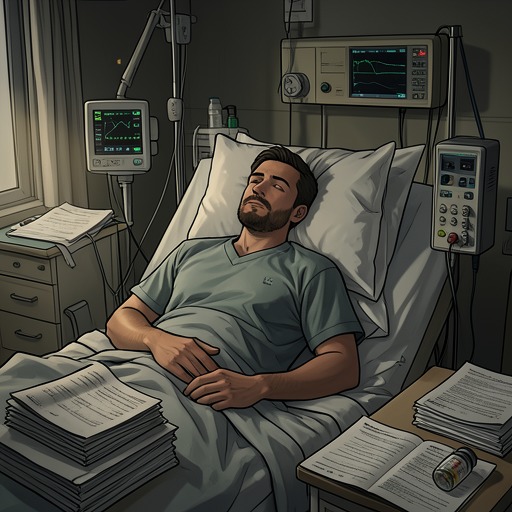
Mickey Haller’s recovery from addiction
The Brass VerdictMickey Haller’s recovery from addiction is not a settled chapter of his past but a precarious practice that comes under renewed pressure as he takes on demanding cases. His history gives him insight into Patrick Henson’s effort to stay clean, yet the same pressures he tries to help Patrick withstand—pain, stress, and the desire to escape—remain present in Haller’s own life. Near the end of the Walter Elliot trial, that conflict becomes both an intimate crisis and a vulnerability others may have exploited.
History and the Cost of Addiction
Haller recalls the severity of his dependence through a specific measure: by the time he drove his eleven-year-old daughter home to her mother, he was taking 320 milligrams of OxyContin a day. He crushed and snorted the drug after waking, though his mornings had shifted into the afternoon. The detail makes the addiction part of ordinary responsibility, not a separate episode: he had been driving his child while heavily dependent.
A fall outside his house made that condition visible in a photograph taken in the emergency room. Haller broke a tooth and his nose and opened his forehead; he kept the picture as a reminder. When he later uses the memory to challenge Patrick’s sense that his own conduct was uniquely foolish, Haller is not offering recovery as a simple success story. He is pointing to the danger he himself had normalized, including the risk of driving his daughter while impaired.
Sobriety as Mutual Support
When Haller takes over Jerry Vincent’s cases, Patrick explains that he has made no scheduled payments. He says he has been concentrating on getting and staying right, has no money, and had already given Vincent surfboards that Vincent valued at five thousand dollars, although Patrick believed some were worth more. The objects and the unpaid balance expose the material strain surrounding Patrick’s recovery: he is trying to remain clean while unable to resume his work until his legal matter is resolved.
Haller asks whether Patrick is still clean. Patrick says Vincent had told him sobriety was his only chance of staying out of jail. Their exchange links recovery to an immediate legal consequence, while also showing that the instruction came from Patrick’s former lawyer. Haller responds not by treating the struggle as finished, but by proposing that they help each other for the next few weeks, until Patrick is back on his feet. If either feels the pull, the other can be there to talk.
The offer is reciprocal, but Haller keeps an important reservation to himself: he may need Patrick’s help more than Patrick needs his. In the preceding forty-eight hours, the weight of the new caseload has begun to draw him toward pills again. He describes the temptation as a desire for the distance they provide, a cotton-wrapped world set apart from the hard reality he faces. The pact therefore marks a real source of support, but not proof that the danger has passed.
Pressure and the Return of Craving
At the end of the trial day, Haller sends Patrick to the movies because he wants the house to himself, without television, conversation, interruption, or anyone watching him. He tells Harry Bosch he is staying in for the night, but his reason is neither preparation for the likely final day of trial nor a lack of readiness: he has the French police captain prepared to offer the jury another dose of reasonable doubt. What keeps him alone is the emotional aftermath of the case.
Haller feels bruised by how effectively he has been used and by his own failure to remember the rule that everybody lies. He is also troubled by the consequences of defending a client he knows is guilty. The family of Johan Rilz has gone home rather than watch their dead relative dragged through the American justice system. Haller has long defended guilty, sometimes evil clients, but this case leaves him unable to feel at ease with the work he is about to do.
In that state, he feels the strongest desire to return to his old ways. He wants a pill for physical pain that would also numb the internal pain. The trial’s coming verdict becomes, in his mind, a verdict on himself: he feels guilty, and believes there will be no more cases after this one. Recovery is thus placed beside a professional reckoning. The threat is not merely the return of physical dependence; it is the possibility that emotional distress and the moral weight of his work will make escape seem preferable to continuing.
Recovery as a Targeted Vulnerability
Haller later explains to Bosch why a staged death could be made to look plausible. As a recovering addict, he says, he could be portrayed as unable to bear the pressure and attention surrounding the major case, relapsing or fearing relapse, and choosing what they call the fast out rather than returning to addiction. He points across the clearing toward juror number seven and reasons that the people behind the scheme had investigated him closely enough to find his addiction, rehabilitation, and Lanie Ross’s name.
That explanation is Haller’s account of the plan, not an independent confirmation of every detail. Its significance lies in how recovery becomes usable against him: a history that helps him recognize Patrick’s danger can also be recast as a convincing explanation for his removal. Haller believes the conspirators could make a suicide seem less likely to draw the scrutiny that another lawyer’s shooting would provoke, and concludes that they think he knows too much. His sobriety is therefore both a private struggle and part of the opposition’s supposed strategy.
Lanie Ross’s apparent relapse sharpens that fear. A caller reports finding her on Mulholland Drive, unable to drive and apparently passed out after handing over Haller’s card. Haller immediately fears that an arrest would send her back into the system and might cost her another stay in jail and rehabilitation. Her crisis does not establish that Haller has relapsed; instead, it shows how closely addiction, legal exposure, and the prospect of institutional treatment sit together in his thinking. The evidence leaves Haller’s recovery unresolved: mutual support exists, but so do renewed craving, emotional pain, and the possibility that his past will be used to undermine him.